Finding Weak Magnetic Signatures in Noise
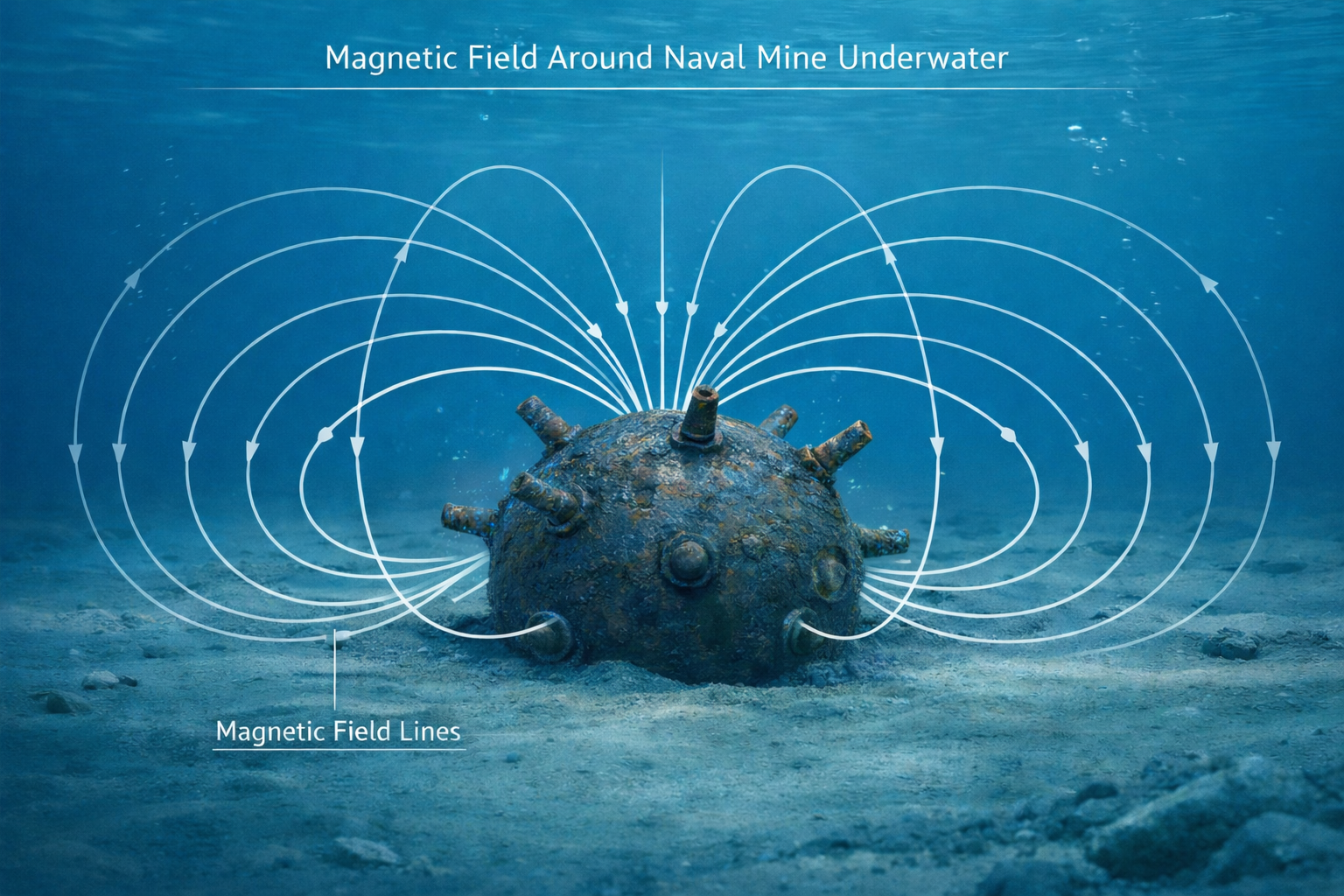
Ferrous objects disturb the Earth's magnetic field, producing anomalies that can be measured without transmitting energy. This makes magnetic sensing inherently passive, with applications ranging from humanitarian demining and underwater ordnance detection to vehicle monitoring and security.
The challenge is that target signatures can be extremely weak relative to geological variations, environmental interference, and sensor or platform noise. Detecting these signals requires more than simple amplitude thresholds. It requires methods that distinguish the structure of a genuine target signature from the surrounding noise and clutter.
Omega Sensing Technologies develops physics-based signal processing and statistical detection methods designed to identify weak magnetic anomalies in challenging environments.
How It works
Physics-Based Modeling
We model magnetic signatures using the physics of magnetic sources and their interaction with sensor geometry and motion. These models provide a physical basis for distinguishing plausible target signatures from background variations and unrelated disturbances.
Wavelet-Based Detection
Wavelet analysis reveals localized magnetic anomalies across time and scale, helping identify weak, transient signatures that may be obscured by broadband, nonstationary noise. Scale-dependent energy analysis and statistical noise modeling support detection thresholds that adapt to background conditions rather than relying on fixed amplitude limits.
Statistical Inference and Machine Learning
We frame detection and localization as statistical inference, using the structure of measured signals and their physical characteristics to distinguish targets from noise and clutter. Machine learning can complement these methods for target classification and false-alarm reduction where appropriate.
Applications
Underwater Unexploded Ordnance UXO
Passive magnetic sensing for detecting and localizing magnetic objects on or beneath the seabed, supporting surveys from autonomous underwater vehicles and remotely operated platforms.
Land Mines and Buried Ordnance
Magnetic anomaly detection to support humanitarian demining, unexploded ordnance surveys, and route clearance, helping identify potential hazards without transmitting energy into the environment.
Vehicle Detection and Tracking
Magnetic sensor arrays for detecting vehicle signatures, estimating passage times, and supporting vehicle classification and tracking in transportation and monitoring applications.
Defense and security
Passive magnetic monitoring for detecting magnetic targets near protected facilities, along perimeters, and in other security-sensitive environments, including applications where low-signature sensing is advantageous.